
Professional Artificial Turf Cleaning in Richland Hills, TX
Richland Hills is a compact, close-knit community surrounded by North Richland Hills and Hurst, known for its affordable housing, strong neighborhood associations, and convenient location in the heart of the mid-cities area. Despite its small size, Richland Hills has a strong community identity, and local homeowners take pride in their properties — including their artificial turf installations.
Why Richland Hills Chooses Tejas Turf
Richland Hills homeowners appreciate our flexible scheduling and transparent pricing. As one of Tarrant County's smaller cities, Richland Hills doesn't always get the attention from large service companies that its neighbors receive. We treat every Richland Hills client with the same priority as our Southlake and Keller accounts.
- DFW's #1 rated turf cleaner — now serving Richland Hills
- Industrial-grade extraction outperforming any competitor in DFW
- Child & pet-safe sanitizing treatments
- Guaranteed odor neutralization — or we come back for free
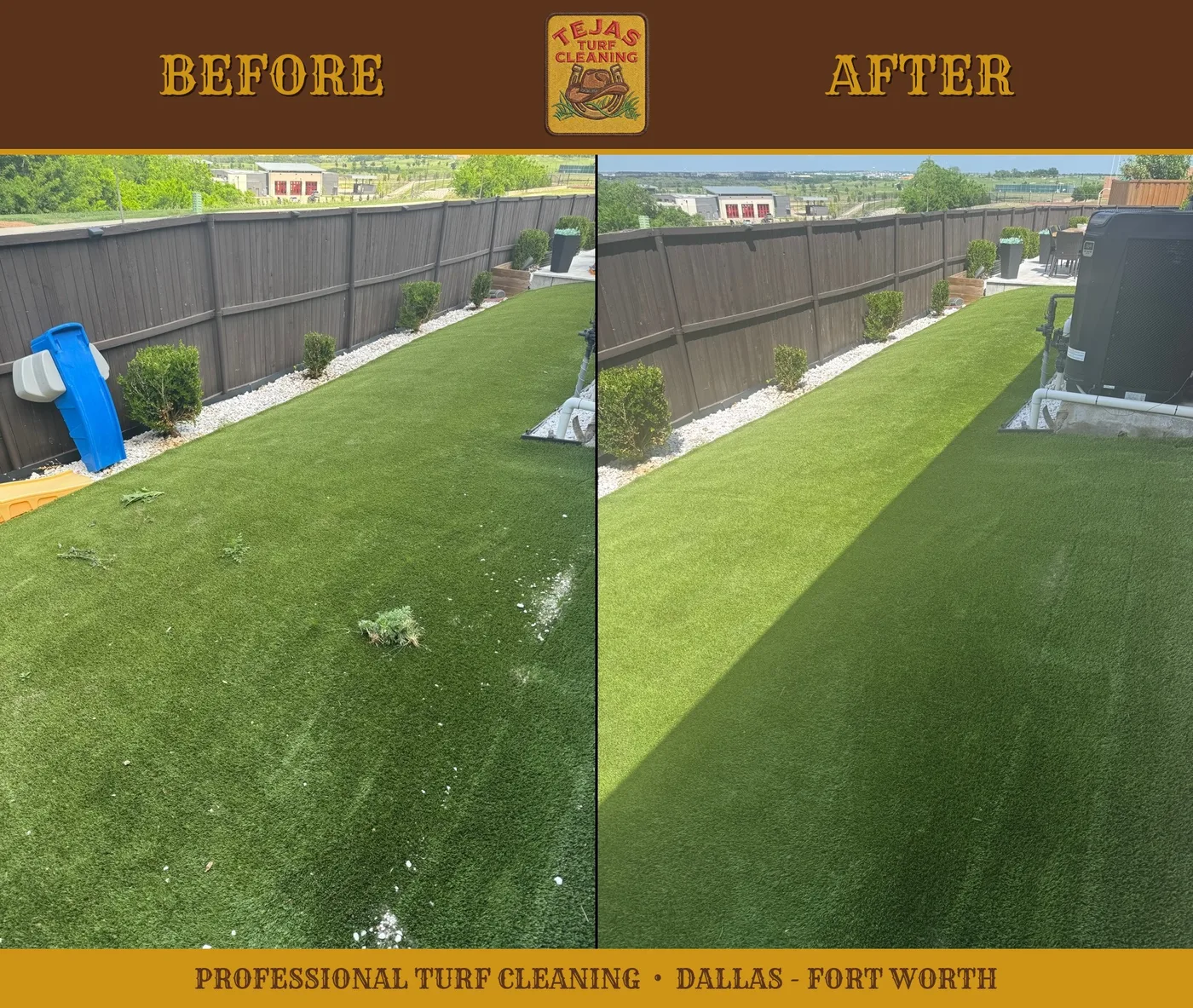
Richland Hills Neighborhoods We Serve
Richland Hills is one of the smallest incorporated cities in Tarrant County — approximately 8,000 residents packed into a compact footprint between North Richland Hills, Hurst, and Fort Worth. The city's residential character is predominantly mid-20th-century: brick ranch homes, mature street trees, established neighborhood identity, and homeowners who take genuine pride in maintaining properties that have been in families for decades. The Glenview area along Glenview Drive is the city's most recognized residential address — an established block pattern with mature elm and oak trees and homes that are steadily being updated by both longtime residents and new buyers who recognize the value in the city's central location.
The Baker Boulevard area creates the city's primary commercial-residential interface — homeowners on the residential blocks just off Baker deal with more commercial traffic exposure than Richland Hills' more interior neighborhoods. The Handley-Ederville Road corridor forms the city's eastern boundary with Fort Worth, and the neighborhoods along this corridor have a blended character that makes them feel continuous with northeast Fort Worth's established residential fabric. Scruggs Park provides green space that anchors a family-oriented zone in the city's center, and the surrounding residential blocks have seen growing artificial turf adoption as homeowners seek to reduce the irrigation and maintenance burden of natural grass while improving their outdoor spaces.
Richland Hills' small size is genuinely an asset for homeowners seeking responsive local service — and it's something we understand well. We're in Richland Hills regularly, we know the city's neighborhoods, and we treat every property — regardless of its size — with the same professional attention.
Common Turf Problems in Richland Hills
The mature tree canopy throughout Richland Hills' established neighborhoods creates the most significant recurring turf maintenance challenge for the city's homeowners. Glenview's century-old elms and the mature oaks throughout the interior residential blocks drop substantial volumes of organic material across fall and winter. Unlike newer suburban neighborhoods where planted trees are young and debris is minimal, Richland Hills' established canopy generates debris loads that accumulate in turf infill through multiple seasonal cycles. A quarterly cleaning schedule that includes post-fall service is the minimum appropriate cadence for most Richland Hills properties with significant canopy overhead.
Richland Hills' older residential infrastructure creates a drainage consideration that newer neighborhoods don't face. Streets, drainage channels, and grading in mid-century developments were designed before the expectations of modern turf systems — and some Richland Hills properties experience rain events that direct runoff onto turf areas in ways that weren't anticipated in the original lot design. When turf drainage slows or water pools after rain, infill compaction from accumulated organic material is frequently the culprit, not the underlying drainage infrastructure. Professional deep extraction often resolves what homeowners assume is a grading problem.
The same heavy Tarrant County clay soil affects Richland Hills properties. The city's compactness and mature development mean less active construction nearby than in Saginaw or Mansfield, but the existing clay soil still creates year-round dust infiltration into turf infill, particularly during the dry months when wind picks up and carries clay particles from bare soil areas.
Frequently Asked Questions — Turf Cleaning in Richland Hills
Our yard is quite small — is it worth calling a professional company for a small Richland Hills yard? Absolutely. We service yards from 150 sq ft up to 6,000+ sq ft with equal professionalism. Smaller yards are straightforward and quick to service — our pricing ensures that even small Richland Hills yards receive complete, professional attention. Get a free custom quote for your yard with our instant calculator at /pricing. Carlos A.'s experience above reflects our approach: yard size doesn't change the quality of work, only the time required.
Richland Hills is small and compact — do you have regular availability in the city? Yes — we're in Richland Hills every week and have strong scheduling availability throughout the city. Richland Hills' compact footprint means service visits are efficient and we can accommodate shorter scheduling windows than we sometimes need in more spread-out cities.
Our trees drop a lot of leaves in fall — when's the best time to schedule a cleaning? November is the single most impactful cleaning window for Richland Hills properties with significant canopy — after peak leaf fall but before the first freeze creates organic matter that freezes into the infill. A late-October or November cleaning prevents the winter compaction of decomposing leaves that creates biological growth conditions in spring. Follow this with an April-May cleaning to address any winter buildup, and you have an effective two-visit annual plan for most tree-covered Richland Hills yards.
We're in Birdville ISD — does that affect scheduling? No. We service Richland Hills throughout Birdville ISD boundaries without distinction. School district zone has no effect on scheduling or pricing.
Schedule Your Turf Cleaning in Richland Hills Today
Richland Hills residents deserve the same professional turf service as any larger community in DFW — and we deliver it. Call (469) 298-8690, text us, or get a free quote online. Same-week scheduling available for most Richland Hills residential properties. Also serving nearby North Richland Hills, Hurst, Haltom City, and Fort Worth.
They treated our small Richland Hills yard with the same professionalism as if it were a mansion. Really appreciated the attention to detail.
— Carlos A., Richland Hills
Our Services in Richland Hills
We offer four professional turf care treatments in Richland Hills: deep cleaning & reblooming, pet odor removal, infill replenishment, and turf repair. Our professional-grade sanitizer kills the mold, mildew, and bacteria that actually cause the odor — and stays safe for kids and pets once dry. We also offer professional grill & outdoor kitchen cleaning in Richland Hills — book it alongside your turf service to save the trip charge.
Turf Cleaning Cost in Richland Hills
We use transparent, square-footage based pricing with no hidden fees. Every Richland Hills yard is priced by its size, turf condition, and the services you choose — get your free custom quote in seconds with our instant calculator, no home visit required.
Reblooming is included with every deep clean, and recurring plan members save up to 15% on every visit.
No fuel surcharges. No equipment fees. The price we quote is the price you pay.
Richland Hills Turf Cleaning Frequently Asked Questions
Industries We Serve in Richland Hills
Tejas Turf cleans synthetic turf for residential homeowners and a wide range of Richland Hills businesses and institutions.
Also Serving Nearby Areas
We serve Richland Hills and all surrounding communities in Tarrant County and across the DFW metroplex.